Recommended Servers
Standalone Deployment Mode
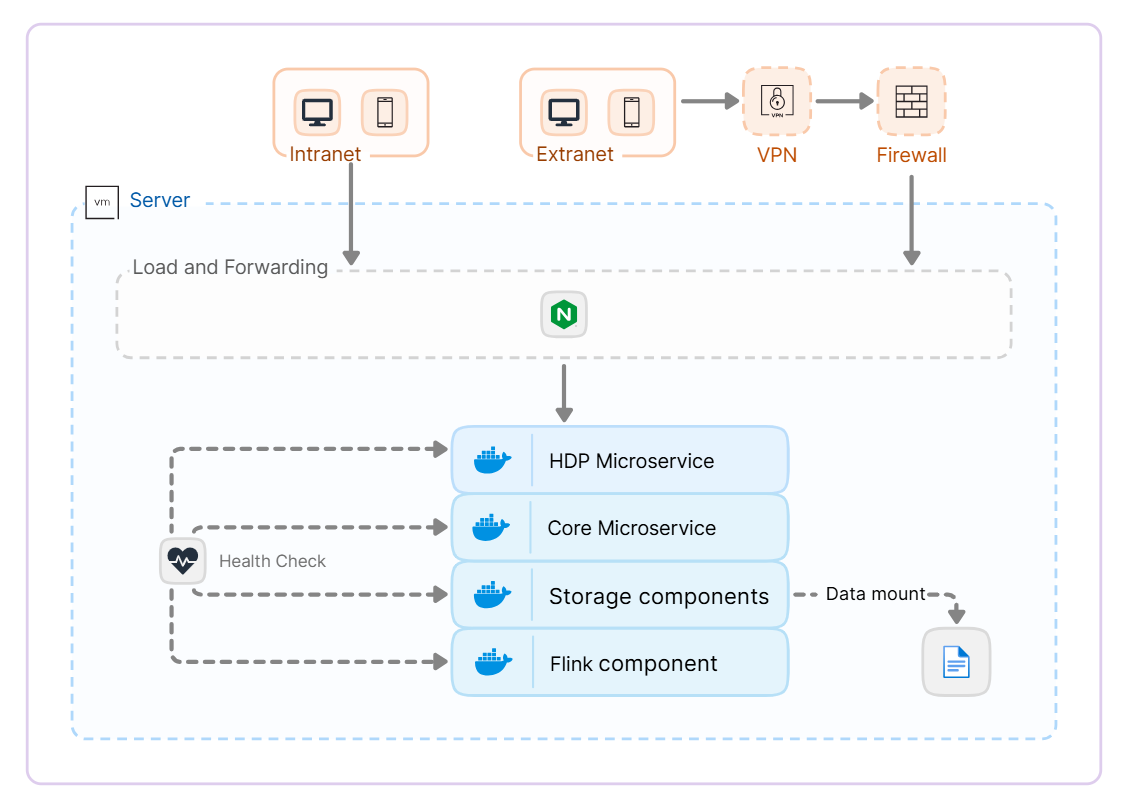
Advantages: Simple and fast deployment, low server resource and operations costs, suitable for testing or small-scale use.
Disadvantages: There is a single point of failure, with components competing for CPU, memory, and disk IO.
The recommended server configuration is as follows:
In order to ensure that the system maintains stable and efficient operation capabilities in complex and diverse business scenarios, combined with the actual deployment situation and load performance of multiple environments, it is recommended that the cluster mode be preferred for the production environment. If standalone mode is used, it is recommended that the memory configuration be no less than 32GB.
|Number of synchronization tasks|Configuration|Operating system |:----|:----|:----|:----:| |A small number of tasks (basic test)|4C/16G/40G system disk/100G SSD data disk|Debian 12| | 1~20|8C/32G/60G system disk/500G SSD data disk|Debian 12| |20 and above|Recommended to use cluster mode deployment|-|
4C/16G is only used for functional testing of a small number of tasks and is not recommended for use in production environments. 16C/64G is used for 1 to 20 synchronization tasks. The single-machine production environment uses 500G SSD data disks and is expanded based on the actual data volume, log volume and retention period.
Cluster Deployment Mode
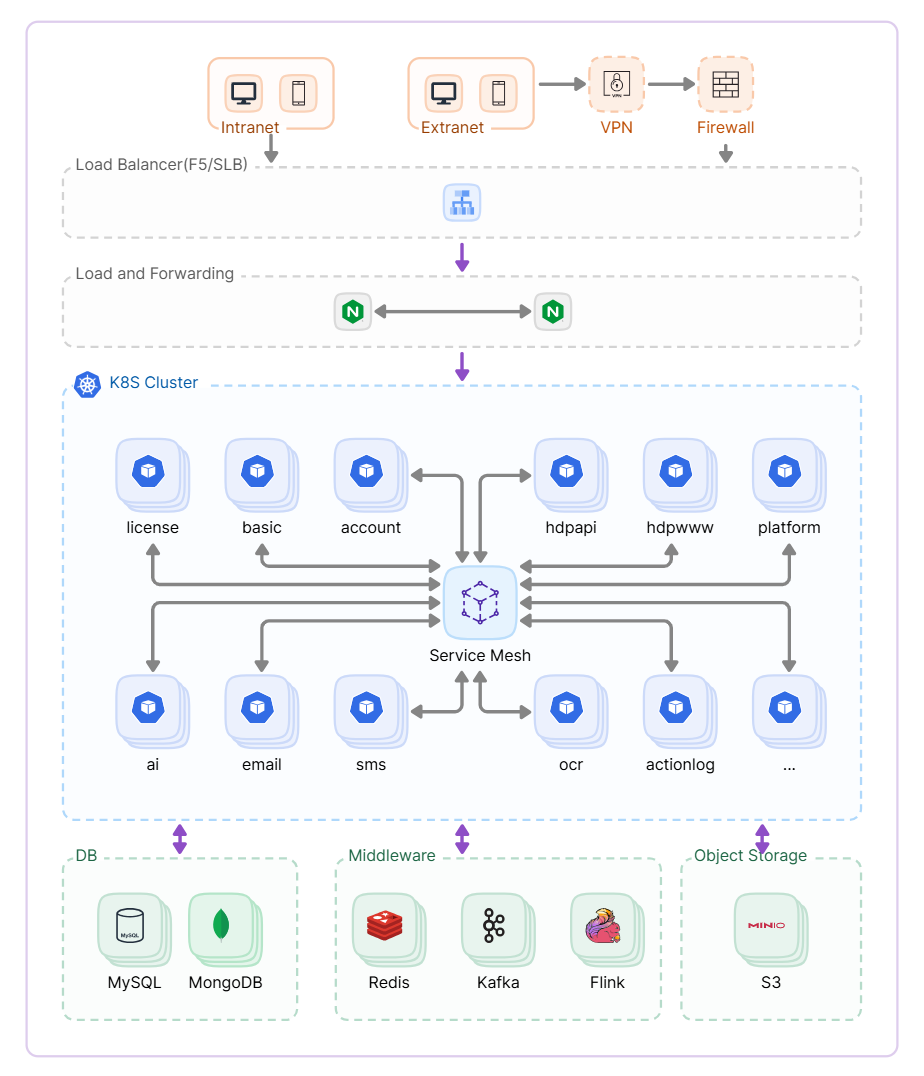
Advantages: It has basic high-availability capabilities, such as node redundancy and automatic fault tolerance, which are more expensive and can make better use of server resources. Can meet most application scenarios
Disadvantages: There is interference and resource competition between different storage components. Pay attention to resource allocation and management.
The recommended server configuration is as follows (number of synchronization tasks 20+):
| Purpose | Configuration | Operating System | Deployment Service | Quantity |
|---|---|---|---|---|
| Load and forwarding | 4C/8G/60G system disk/200G SSD data disk | Debian 12 | Nginx | 2 |
| Microservice application | 8C/16G/60G system disk/200G SSD data disk | Debian 12 | Microservice | 2 |
| Database and cache service | 8C/16G/60G system disk/300G SSD data disk | Debian 12 | MySQL, MongoDB, Redis | 3 |
| Middleware | 8C/16G/60G system disk/500G SSD data disk | Debian 12 | Kafka, MinIO, file service | 4 |
| Data synchronization | 8C/32G/60G system disk/500G SSD data disk | Debian 12 | Flink | 2 |
Two Flink nodes are used to share computing resources. The number of Flink nodes can continue to expand according to the scale of synchronization tasks. For more than 50 synchronization tasks, nodes should be added based on single task resource consumption.