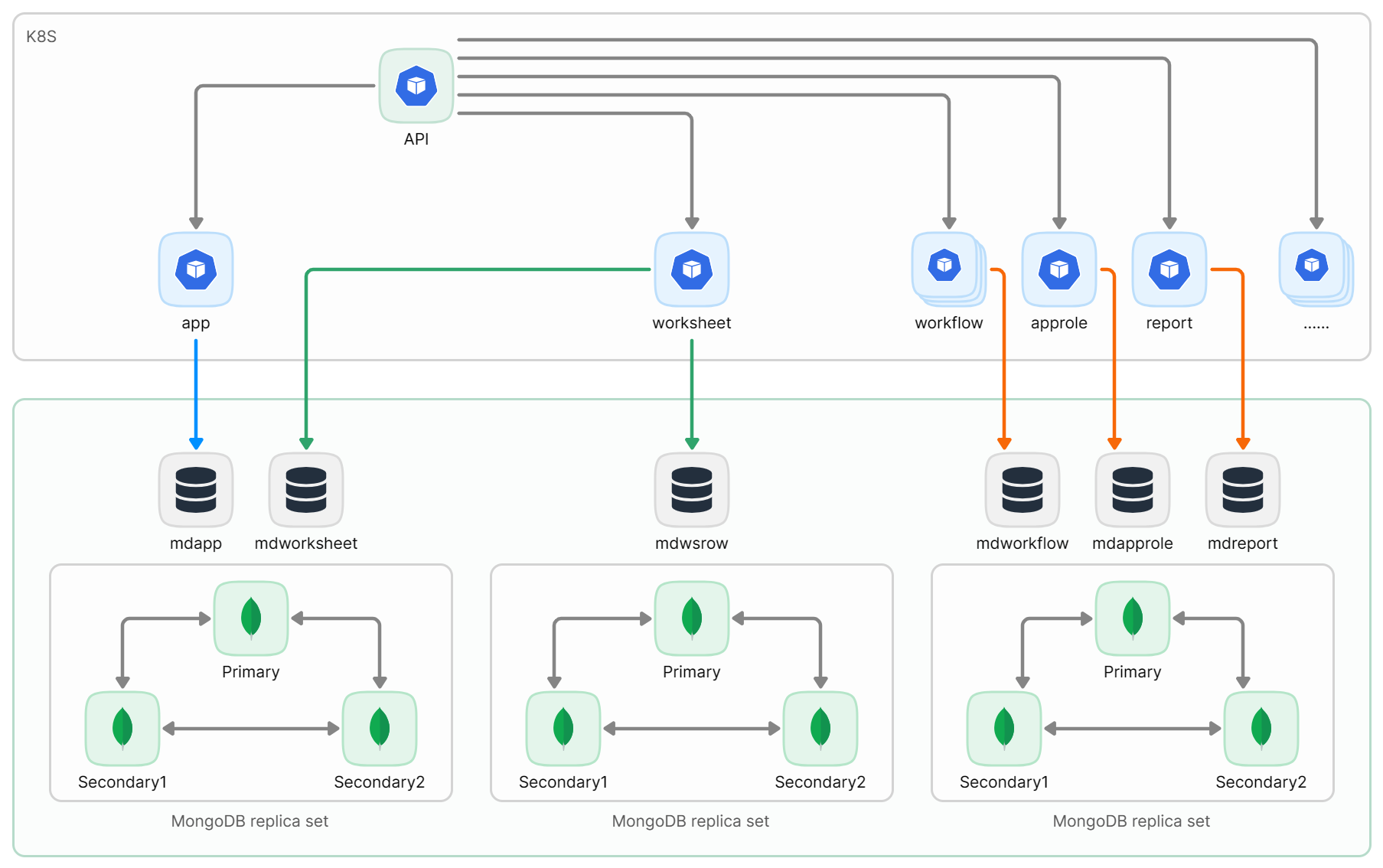
Multi-cluster Storage for Application Data
In the default deployment mode, HAP only needs one MongoDB cluster to store application data. For the basic storage architecture, see Application Data Storage Architecture.
Applicable Scenarios
As the number of applications, worksheets, and row records continues to grow, a single MongoDB cluster may encounter bottlenecks in CPU, memory, disk I/O, or connection count. In this case, multi-cluster storage can be enabled to distribute different databases across different MongoDB clusters and reduce the resource pressure on a single cluster.
Implementation
Multi-cluster storage can also be understood as vertical partitioning. The system allocates data by database, with one database corresponding to one MongoDB cluster as the minimum granularity.
After this mode is enabled, databases for different business modules or data scales can be deployed to independent clusters. This isolates resource consumption and makes it easier to independently scale, migrate, or maintain data by database.
Points to Note
Multi-cluster storage increases deployment and O&M complexity. Before enabling it, evaluate the data growth rate, cluster resource utilization, and O&M capability to avoid splitting too early when the data scale is still small.